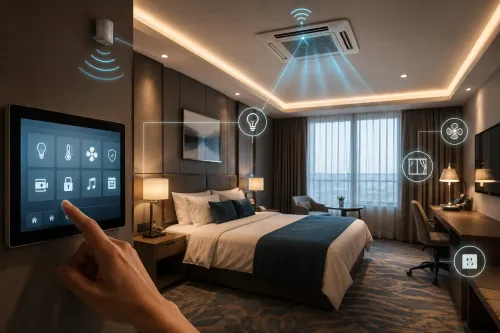

The modern office has changed significantly over the last decade. Flexible work models, digital collaboration, and increasing operational costs have encouraged businesses to rethink how their workplaces function. As a result, smart office solutions have become an important investment for organisations that want to improve efficiency while creating a better experience for employees and visitors.
Across Gurugram, one of India's fastest-growing commercial hubs, businesses are adopting intelligent workplace technologies that simplify everyday operations. From automated lighting and climate control to integrated meeting rooms and access management, smart offices are helping organisations work more efficiently without adding unnecessary complexity.
If your business is considering workplace automation, understanding what a smart office actually offers is the first step toward making the right decision.
What Is a Smart Office?
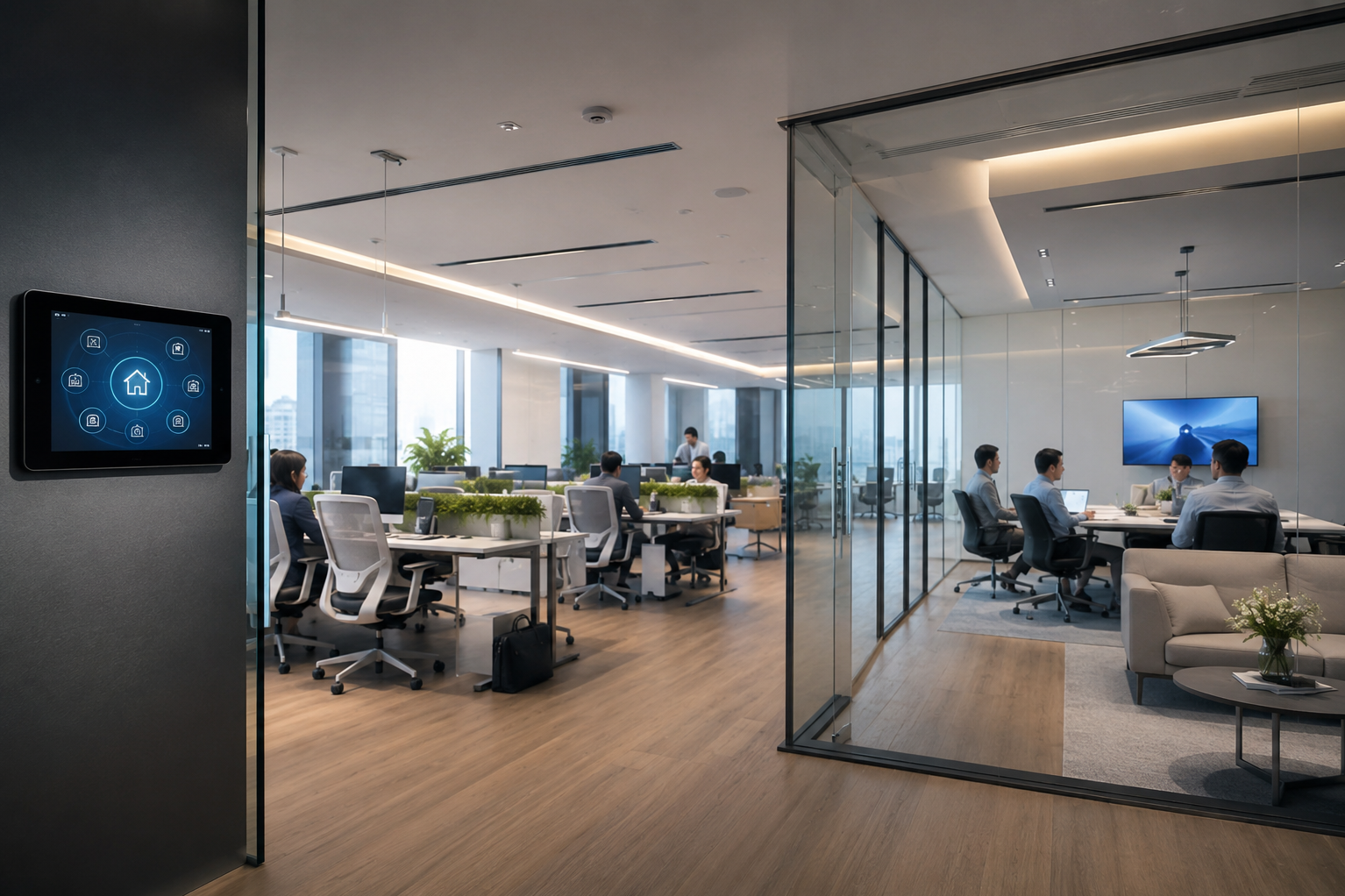
A smart office combines automation, connected devices, and intelligent control systems to improve how a workplace operates.
Instead of managing different systems independently, essential office functions communicate through a unified platform.
A smart office may include:
- Intelligent lighting systems
- Smart climate control
- Automated meeting rooms
- Digital access control
- Visitor management systems
- CCTV surveillance
- Occupancy sensors
- Audio and video integration
- Energy monitoring
- Centralised control dashboards
The objective is not simply to introduce technology but to create a workplace that responds efficiently to changing business needs.
Why Businesses Are Investing in Smart Office Technology
Workplace automation delivers value in several ways beyond convenience.
Businesses increasingly adopt smart office solutions because they help improve:
- Employee productivity
- Energy efficiency
- Workplace security
- Space utilisation
- Operational consistency
- Facility management
- Long-term cost control
As organisations expand, automation also makes it easier to manage larger workspaces without proportionally increasing administrative effort.
Better Use of Office Space
One challenge many businesses face is underutilised meeting rooms and shared workspaces.
Smart office systems help organisations understand how office spaces are actually being used.
For example:
- Occupancy sensors identify unused meeting rooms.
- Booking systems reduce scheduling conflicts.
- Lighting and air conditioning activate only when rooms are occupied.
- Shared workspaces become easier to manage.
This leads to more efficient use of office infrastructure while improving the employee experience.
Intelligent Meeting Rooms Save Time
Meetings often lose valuable time because of technical issues.
Smart meeting room solutions simplify the process by automating common tasks.
Employees can walk into a conference room where:
- Displays are ready to use.
- Video conferencing systems activate automatically.
- Lighting adjusts for presentations.
- Window blinds operate with a single command.
- Air conditioning maintains a comfortable environment.
Instead of troubleshooting equipment, teams can focus on productive discussions.
Workplace Comfort Matters More Than Ever
Employee wellbeing has become an important consideration for modern organisations.
Automation helps maintain a comfortable working environment throughout the day.
Examples include:
- Adjusting indoor temperatures automatically.
- Controlling natural and artificial lighting.
- Improving indoor comfort through scheduled climate settings.
- Reducing glare during presentations.
- Maintaining consistent working conditions across departments.
Comfortable workplaces often contribute to higher employee satisfaction and improved concentration.
Energy Efficiency Supports Business Sustainability
Commercial buildings consume substantial amounts of electricity every day.
Smart office automation helps businesses optimise energy use without affecting daily operations.
Practical examples include:
- Switching off lights in vacant areas.
- Scheduling HVAC systems according to office hours.
- Monitoring electricity usage through digital dashboards.
- Using daylight sensors to reduce unnecessary lighting.
- Managing equipment automatically after office hours.
Over time, these improvements support both sustainability goals and operational cost savings.
Security Becomes More Intelligent
Protecting employees, visitors, and business assets requires more than conventional security systems.
Smart office solutions integrate multiple technologies into one platform.
These may include:
- Digital access control.
- CCTV surveillance.
- Visitor registration.
- Motion detection.
- Remote monitoring.
- Emergency notifications.
Facility managers gain better visibility while reducing the need for manual monitoring.
Questions to Ask Before Investing in Smart Office Solutions
Every workplace has unique operational requirements.
Before implementing automation, business owners should consider:
- Which daily tasks consume the most time?
- Can the automation system grow with the organisation?
- Will different technologies integrate smoothly?
- Is the system easy for employees to use?
- What level of technical support is available?
- Can future office expansions be accommodated?
Careful planning ensures that automation remains valuable for years rather than becoming outdated quickly.
Why Professional Planning Delivers Better Results
A smart office performs best when every system works together seamlessly. Installing standalone products from different manufacturers often creates compatibility issues and increases management complexity.
Experienced automation specialists help businesses design integrated solutions that match their workflow, office layout, and future growth plans. Companies such as Domotics Automation Pvt. Ltd. develop intelligent workplace automation systems that combine lighting, climate control, meeting room technologies, security, and access management into one connected platform. Businesses can also explore these solutions through sales.domotics.co.in to better understand how workplace automation can be tailored to their operational needs.
As commercial spaces continue to evolve across Gurugram, smart office solutions are becoming an important part of business infrastructure rather than an optional upgrade. Organisations that invest in well-planned automation today are creating workplaces that are more productive, energy-efficient, secure, and prepared for the future.